
Skip to Content

BS/MSE Program

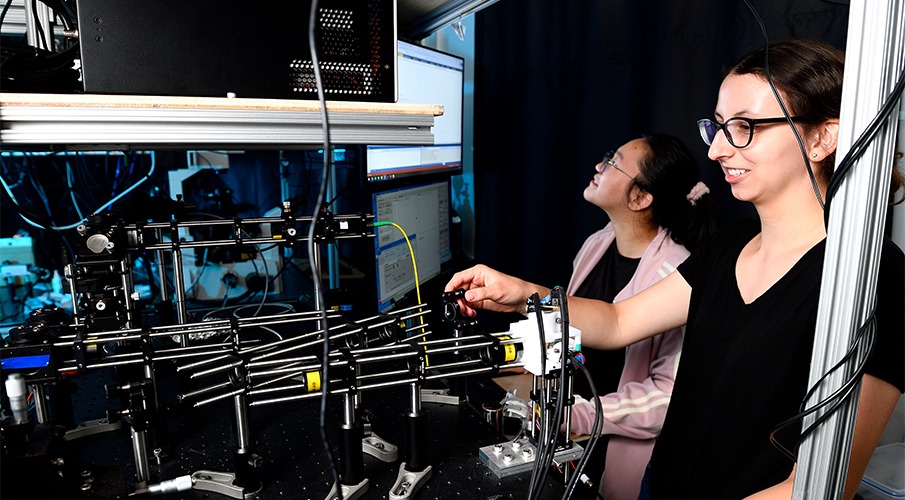
Two female students are working in a lab.

The Newest Edition to Our Suite of Master's Degree Programs

The BS/MSE combined degree program is open for eligible candidates interested in pursuing MSE studies in biomedical engineering. BS/MSE combined degree graduates may finish the program within or before five years, or opt to include an additional research thesis year. Graduates from this flexible program are competitive for careers in industry and medicine, as well as PhD and medical school programs.

Application Date: October 1 of senior year (for any JHU student) 

Application Components

  1. Resume
  2. JHU unofficial transcript
  3. Two letters of recommendation (strongly advise academic and a research advisor if available)

Program Description

The combined bachelor’s/master’s (BS/MSE) in engineering program enables undergraduates to apply for and begin taking courses towards a master’s degree before completing their bachelor’s degrees. It is not necessary for your undergraduate major and your master’s degree to be in the exact same field. Mixing degrees is also an alternative to undertaking a double major in a closely related field, such as a combination of biomedical engineering and computer science or math. We welcome applicants from across the JHU schools! 

Many combined degree graduates finish the program within or before five years, shortening the time to a set of degrees that strengthen your position for later jobs and applications.  

As a BS/MSE student, you must satisfy all the requirements of your bachelor’s degree as well as all the requirements of our Master of Science in Engineering degree. The Whiting School requires that: 

  • an undergraduate student applies to a combined student status no later than the end of the first semester of their senior year (typically a student’s 7th semester), or in other words, their second-to-last semester of undergraduate study
  • undergraduate students be admitted or enrolled to a combined bachelor’s/graduate program no later than the start of their eighth/final undergraduate semester
  • combined bachelor’s/graduate program cannot apply after their undergraduate degree has been conferred (standard application pathways are needed in this case)

There are a few benefits to this dual degree from biomedical engineering:

  • Applications for the combined BS/MSE student do not require an application fee, official transcript or a statement of purpose, reducing the time and cost of your MSE application and degree.  
  • Whiting School of Engineering’s Dean’s Master’s Fellowship will pay 50% of the student’s tuition every semester (fall and spring only) while they are a full-time graduate student after completing eight semesters and a bachelor’s degree (fall and spring semesters only). 
  • Admission is non-binding. The department understands that students may change their minds or be offered an opportunity outside the combined BS/MSE that is a better fit for their aspirations. 

BME Combined BS/MSE Program 

Course-Based Degree

Students must complete at least 30 credits of approved graduate level coursework to satisfy the course-based degree option requirements.  

Any Johns Hopkins graduate course (typically 600- or 700-level) in math, science, engineering, or medicine/public health qualifies. In some cases, advanced undergraduate level (i.e., 400-level) courses are allowed if a corresponding 600-level course is not taught. MSE students have the option to count up to six credits of research (three credits per semester with a confirmed lab) as well as up to two seminars (typically one credit each) towards their overall 30 credits. 

Students are NOT REQUIRED to select a focus area or complete specific coursework. We do encourage you to review the focus areas, as the courses within each identify cohesive learning within that discipline and show transcript-based evidence of a strong degree. 

Thesis-Based Degree Option

Every student has the option to pursue a thesis-based degree, typically two semesters of full-time research. To enter the thesis year, each student must complete the same requirements as noted under the course-based degree option. Upon completion of the course requirements during the first year, students will begin a second year of research only, which will lead to the submission of their thesis at the end of the second year. 

Students must declare their intentions to pursue the second year of research plus thesis submission in the spring semester of their coursework year by April 1st. 

FAQs

PROGRAM OVERVIEW

What is the BME combined BS/MSE program?

The combined BS/MSE program allows qualified Johns Hopkins students to begin graduate-level coursework while completing their undergraduate degree and continue directly into the Master of Science in Engineering (MSE) in Biomedical Engineering.

Who is eligible to apply to the combined program?

Students currently enrolled at Johns Hopkins and transfer students are eligible to apply.

What academic background is required for admission?

Applicants should typically hold a bachelor’s degree in engineering or a basic science discipline. A strong background in college-level physics, chemistry, mathematics, and biology is expected, and prior programming experience is beneficial. 

Exceptional students from other disciplines may be considered but may be required to complete additional coursework to address gaps in preparation. 

ENROLLMENT AND STUDENT STATUS

Will I maintain undergraduate status throughout the program?

No. Students transition to graduate status once their undergraduate degree is conferred.

Can I be part-time in my final semester?

Not as an undergraduate. If you complete your undergraduate degree and need a final semester to complete your MSE requirements, you can convert to graduate status and apply for part-time status.

DEGREE REQUIREMENTS

What are the requirements for the BME MSE degree?

Students must complete at least 30 credits of approved graduate-level coursework to earn the MSE degree.

Do I need to choose a focus area?

Focus areas are not required, but they are encouraged. Focus areas help students structure coursework to demonstrate depth in a particular domain within biomedical engineering.

What types of courses can count toward the MSE degree?

Students may take approved graduate-level engineering, science, and mathematics courses that are relevant to biomedical engineering. 

If courses are outside BME but closely related (e.g., math, engineering, medicine, or public health), they may count toward elective requirements with advisor approval.

Can undergraduate courses count toward the master’s degree?

Yes. In some cases, advanced undergraduate level (i.e., 400level) courses are allowed if a corresponding 600level course is not taught. Certain 400-level courses taken during the undergraduate degree may count toward the master’s degree, provided: 

  • courses were not already used to satisfy requirements for an undergraduate degree
  • courses are approved by the master’s advisor 
How many undergraduate credits can be double-counted?

Up to eight credits may be double-counted toward the master’s degree and bachelor’s degrees. Courses taken for an undergraduate major may count toward the master’s degree if they meet graduate-level requirements, with advisor approval. 

Can undergraduate courses taken for a minor count toward the master’s degree?

Yes. Up to eight credits may be double-counted toward the master’s degree and bachelor’s degrees. Courses taken for an undergraduate minor may count toward the master’s degree if they meet graduate-level requirements, with advisor approval.

Can courses from outside the BME department count toward the degree?

Yes. Graduate-level courses in engineering, mathematics, science, medicine, or public health may count if they are relevant to biomedical engineering and approved by your advisor. 

How do I register for graduate-level courses toward the master’s degree?

Per WSE policy, students who have been accepted into a combined bachelor’s/master’s status who are still in their undergraduate status may enroll in graduate level courses at the 600-, 700- and 800-levels without needing to obtain the usual instructor and/or advising approvals.  

EXCEPTION: Combined bachelor’s/master’s students still in their undergraduate status cannot enroll in 800-level research courses.

RESEARCH AND SEMINARS

Can seminars count toward the MSE degree?

Yes. All students can count up to two BME-relevant graduate level seminars towards the MSE (typically one credit each).  

These credits may count toward the overall 30 credits, depending on program guidelines. 

Can research credit be counted toward the MSE?

Yes. Students may count up to six credits of graduate level research (800-level) towards the MSE degree.  MSE research must be independent of any undergraduate research project and must be specifically for your graduate studies. MSE students may count a maximum of three credits per semester with a confirmed lab. 

These credits may count toward the overall 30 credits, depending on program guidelines. 

THESIS OPTION

Is there a thesis option for the MSE degree?

Yes. Combined degree students are encouraged to consider the thesis option for deeper research experience.

What does the thesis option involve?

Students complete coursework during the first year of the graduate program and then spend a second year conducting research, culminating in submission of a master’s thesis.

When must I declare the thesis option?

Students must declare their intention to pursue the second year of research and thesis by April 1 of the spring semester during their coursework year.

ADVISING

Who is my academic advisor in the combined program?

While enrolled as an undergraduate student, you will work with your assigned undergraduate academic advisor. 

After transitioning to graduate status, you will be assigned a graduate advisor to guide your MSE coursework and research. 

COMPLIANCE AND TRAINING

Are there any required certifications for graduate students?

Yes. Graduate students must complete Responsible Conduct of Research (RCR) and academic ethics certifications during their first semester in graduate status.

Read the Johns Hopkins University privacy statement here.

Accept