Predicting Rupture Risk in Cerebral Arteriovenous Malformations
- Salma Habib
- Niranjani Komethagavel
- Dhivya Pradeep
- Jiaqiang Wang
- Jaden Tepper
- Annaka Saffron
- Hailey Lee
- Joseph L Greenstein
- Casey Overby Taylor
- Siamak Ardekani
- Ali Uneri
- James Feghali
Abstract:
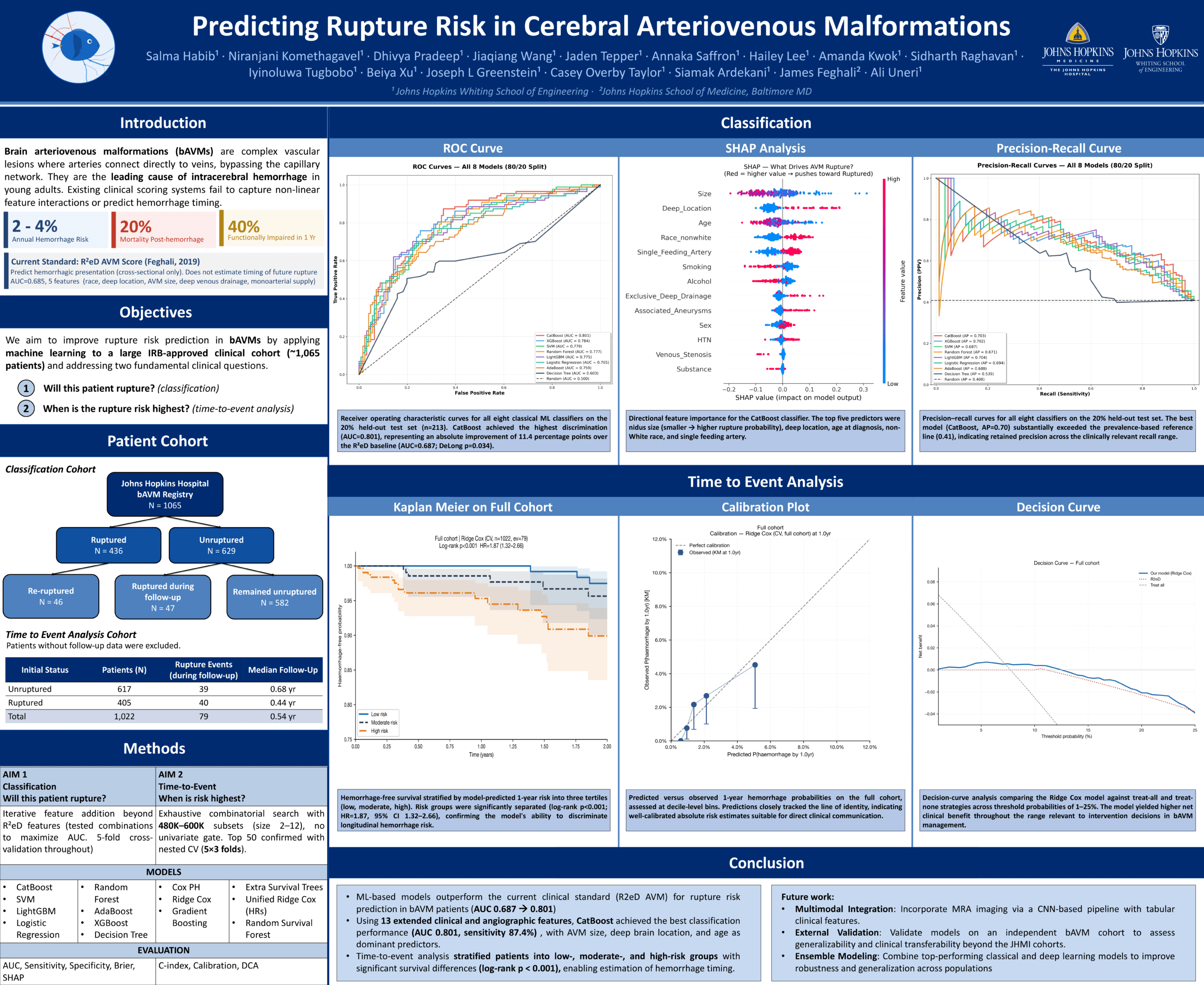
Brain arteriovenous malformations (bAVMs) are complex vascular lesions where arteries connect directly to veins, bypassing the capillary network. They are a leading cause of hemorrhagic stroke in young adults, yet current clinical scoring systems have limited predictive accuracy and cannot estimate when rupture may occur. We developed a machine learning framework using an IRB-approved cohort of 1,065 bAVM patients to improve risk stratification, addressing two clinical questions: whether a patient will rupture (classification) and when rupture risk is highest (time-to-event analysis). Among eight models evaluated, CatBoost achieved the best performance (Test AUC = 0.801), outperforming the standard R²eD score. Ridge Cox survival models further stratified patients into low-, moderate-, and high-risk groups with significant separation of hemorrhage-free survival (log-rank p < 0.001, HR = 1.83). This framework demonstrates the potential of machine learning to enhance clinical decision-making in bAVM management.